

Catholic priest says Malawians should stop electing thieves
Catholic priest Father Ernest Mwinganyama of Mangochi has added a voice on the state of governance in the country by apportioning the blame to Malawians for electing thieves into power and also the existing perceptions that leaders are bosses rather than watchmen.
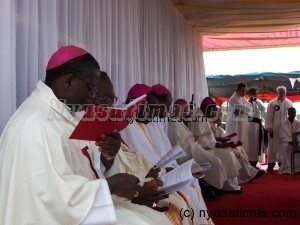
Mwinganyama’s views comes against the background of the Civil Society demonstrations on the dwindling state of governance under the theme “Time to reclaim our destiny” held on 27 April and also the Catholic’s Pastoral Letter issued on 29 April under the theme “A call for a new era in Malawi”.
Delivering a homily centred on the just released Catholic’s Pastoral Letter – which has also gone viral on social media – aired on Radio Maria on Sunday, Father Mwinganyama said by virtue of electing thieves into government Malawians were also accomplice in the current worsening state of governance in the country.
“Some lawyers are busy defending thieves. Is this okay? In Malawi we elect thieves. If we elect thieves then certainly we are all thieves. We can’t honestly say we are not thieves after electing thieves. Worse still, after electing these thieves we continue to shield them. What kind of madness is this…? I am talking here about what the Episcopal Conference of Malawi’s pastoral letter is saying…” preached Mwinganyama.
The priest further gave an analogy of a watchman “mlonda” and his boss “bwana” to stress the point that leaders are supposed to be guided by the voters or peoples will, not their selfish interests.
“All of us know that the job of watchman is to provide security of the property of the owners –his boss. When you elect a President his job is certainly to take care of our property – in this case our taxes and public resources. Just like us priests, chairman Bishops, the President –whatever the party he or she holds – is a watchman. Ironically, some watchmen think that the property belongs to them. They have forgotten that the owners of the property are Malawians. The owners of the property can decide to fire the watchman. A good watchman knows how to respect the owners of the property. The money and public resources we have in Malawi is ours, it’s not for the watchman (the President). It’s our money, though some watchmen are found with this money in their houses. The President is not my bwana (boss). He is my servant. The President to me is a watchman. And sometimes I feel sorry when I hear some of you shouting to the President, “Bwana! Bwana!” How foolish are we?… This is my interpretation of the Pastoral Letter”, said the priest, a highly respected figure in the Catholic Church circles.
Reacting to the homily, Vice Chairperson of Human Rights Defenders Forum Gift Trapence said the ceremony reflects the reality of our democracy in Malawi especially in relation to our politicians who don’t respect Malawians who put them in office.
“There is too much impunity with our political leaders. They don’t respect their employers who are the tax payers. Our democracy can be meaningful if Malawians elects leaders who have the best interest for the people. Leaders who do not condone corruption. Things will change in Malawi if people do not entertain mediocre leadership and stop being passive,” said Trapence, who was also one of the CSO leaders who led Malawians in the 27th April demonstrations over deteriorating governance.
A renowned political commentator Dr Michael Jana- a political science lecturer Wits University in South Africa – said that the priests’ views only confirmed what one of his academic studies had revealed on the subject matter and hence commended the priest for being the change agent on mind-set change.
“In my thesis about 4 years ago, I grappled with determinants of political legitimacy in African emerging democracies. One interesting determinant was the perception of leaders as our parents – and Michael Schwartzberg’s work is instructive in this case. This becomes ironic in that if leaders don’t treat citizens as parents would fend for their children, the parents are deemed to have failed and this affects their performance based legitimacy. On the other hand, treating leaders as parents (as opposed to treating them as employees- Alonda) affects accountability of the leaders to their citizens whom they treat as their ‘kids’. Afrobarometer studies and papers e.g. Logan have addressed this aspect. I am glad that this priest is tackling this subject. He is a social change agent that is reminding us that we need to change our mindset. However, encouragingly the statistics (e.g. Afro barometer) shows that the proportion of Malawians who consider government as their parent (as opposed to mlonda) is going down” said Dr Jana, a former lecturer in the Department of Political and Administrative Studies at Chancellor College.
Adding his voice to the homily, a local governance analyst Makhumbo Munthali said Father Mwinganyama must be commended for clearly reminding Malawians about the principle of Social Contract as laid down in Malawi’s Constitution.
“The priest’s homily augurs well with not only the Episcopal Conference of Malawi’s Pastoral Letter’s call for Malawians to change their mind-set but also the CSO’s 10 point demands petition where the issue of Malawi’s Social Contract principle was quoted.
“While Section 6 of the Republic Constitution implies that a government that has not been elected through universal suffrage does not have authority to govern, Section 12 (c) safeguards the power of the people by implying that a government that no longer has the sustained trust of the people, regardless of the fact that it might have been duly elected through universal suffrage, has no authority to govern, and people have the mandate to remove it in accordance with the law”, said Munthali, a former national secretary of the Ethics, Peace and Justice Commission of Evangelical Association of Malawi and National Advocacy Coordinator for Centre for Human Rights and Rehabilitation.
Follow and Subscribe Nyasa TV :