

Mgumano wa Mang’anja na Sena group launched: Mutharika says cultural interaction promotes unity
President Professor Arthur Peter Mutharika has commended the formation of the Ngumano wa Sena na Mangánja cultural grouping saying such groups promote oneness.
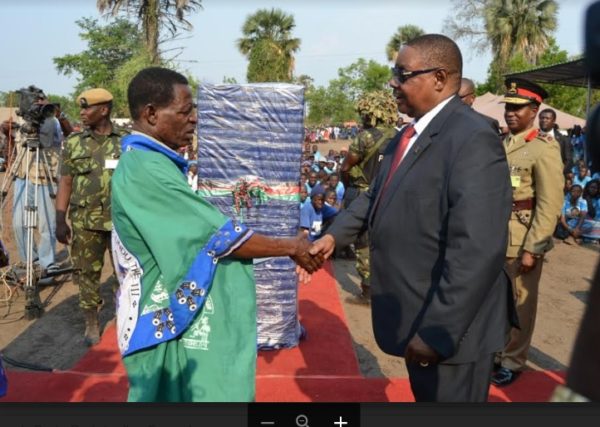
Mutharika made the remarks Saturday when he attended the launch of the Mgumano wa Sena na Mang’anja Cultural Grouping at Paramount Chief Lundu’s Mbewe wa Mitengo Headquarters in Chikwawa District.
In his speech, Mutharika advised the grouping to refrain from various negative cultural beliefs that hinder development and spread diseases such as HIV/AIDS.
“As much as we appreciate establishment of several cultural groupings in the country, let’s all remember that we are one as Malawians and as we participate in these groupings let’s put development issues forward,” said Mutharika.
Minister of Culture, Civic Education and Community Development Cecilia Chazama commended the president for putting into effect the 2015 National Cultural Policy that has seen a lot of tribes forming their cultural groupings.
Chazama said the cultural groupings promote unity and commended Mgumano wa Mang’anja na Sena for enhancing various developmental activities ranging from food security, education as well as observing self dependency and participation towards development initiatives.
Taking his turn, Mgumano wa Mang’anja na Sena Board of Trustees Chairperson Owen Chomanika said the coming together of the two tribes shows appreciation for cultural diversity and co-existence among tribes.
He thanked the State President and all those that took part in supporting the event.
The launched cultural grouping that involves both Senas and Mang’anjas especially in the twin districts of Chikwawa and Nsanje was established in 2010.
Meanwhile, President Mutharika has called on all Malawians to observe a week of prayer from October 22 regarding the blood sucking rumors that have rocked the southern part of the country.
“The only way to defeat Satan, who could be the source of this, is by calling for God’s intervention so that peace is restored in the country,” said Mutharika adding that after three to four weeks of monitoring what was happening, no tangible results have been found.
Moreover, he said even medical practitioners have not found any evidence regarding the bloodsuckers.
The President said the prayers can be held in various places in the country be it in homes, churches, mosques and any place where people are comfortable.
Follow and Subscribe Nyasa TV :
I am one who has several times protested that the Mang’anja are not the Chewa. And I repeat they are not. I am happy, very happy indeed that Lundu and the Sena have formed their tribal grouping. Woyamilkila is wrong and he got his history wrong too. The Chewa and Mang’anja indeed came from DRC but were not one. The Chewa picked the Mang’anja on their way. As a gesture and for harmonious travel together they established a relationship to cement a bond along their long way to Nyasaland. The Chewa have a tendancy of calling everyone they meet and travel together a brother, sister and cousin. That brotherly calling was not blood related. The Mang’anja should not have taken it literally. That was why it was necessary to settle at different places when they arrived here.
It is also untrue that the Chewa of lake shore are sidelined. It is actually politicians and some tribes who use religion – Islam to separate the Chewa. They call lake shore brothers and sisters Chipeta as a tribe. Chipeta means short grass mostly found along the lake shore. It is not a tribe. It is an insult to call Chewas of lake shore Chipeta. It is an attempt by greedy politicians and other tribes to reduce the numbers of Chewas. There are no sub-groups within the Chewas. We know there are attempts to remove the Chewas from malawi’s social, cultural, political and economic stages.
You Chewas from the Central Region leave us alone. You are arrogant, self-centred, egocentric and you name it. You never consider Nyanjas and Mang’anjas from the Southern Region as part of your tribe in everything you do. Look at you Malawi Chefo committee, it is only full of Chewas from the Central Region. You always look down upon Chief Lungu at every given opportunity. Most of you have publicly declared that he is not a true Chewa chief. When you hold meetings you do not include Mang’anjas and Nyanjas, it is always Chewas from the Central Region. Imagine even considering Atupele Muluzi, a Yao, as a more Chewa than the so many mang’anjas and Nyanjas that we have around. As if this is not enough you even exclude Nyanjas from the Central Region in the districts of Nkhotakota, Nkhatabay, and Salima. As long as they are not Chipetas from the Central Region, they are not Chewas enough for you.
Don’t try to politicise this. It is purely as a result of the arrogance and self-centredness of the Chewas from the Cebntral Region that has fuelled the establishment of this grouping. You have always taken Mang’anjas and Nyanjas as being inferior or non-chewas. You only want them now for political reasons and nothing else. Mukagwere. Patsogolo ndi Ngumano wa a Sena na Mang’anja and backward never.
Woyamikila, you are right. Politics has been at the center of most of these things. Actually, politicians from both the ruling and opposition parties tend to influence what happens about the Lundu chieftaincy – God forbid! Like I already said above, political interference dates back to the colonial rule when the whites wanted to divide up the Chewa people so they can easily control them. They actually erased this chieftaincy until 1969 when Dr. Banda restored it and made Lundu Paramount Chief. What you now see the DPP government doing is the same thing. They are trying to separate Lundu and the so-called “Nyanja” or “Mang’anja” from the Central Region Chewas.
I will not be surprised if they (DPP government) erroneously declare him “paramount chief” of the Mang’anja/Sena people like they have done with Ngolongoliwa of Thyolo. Again, whether Lundu would accept such an appointment is what we all should wait and see. The point is: a strong Lundu is what every politician does not want to have due to the negative influence he may have on their political destiny when they cross paths with him. My view though is that Lundu will reject it outright since he knows that taking that status will “weaken” him and not strengthen then as a chief. He may, instead, delegate one of his senior chief (most likely his young brother Senior Chief Tengani) to assume such a responsibility although I don’t see him taking such step knowing that “atambala awiri salira mkhola limodzi”. Most likely, he will dissolve the Mang’anja/Sena Association once government changes hands in future.
If you noticed, when asked to speak during the Mang’anja/Sena Association launch, Lundu did not pick anybody from Lower Shire (a “Mang’anja” to speak on his behalf as chiefs normally do. He, instead, asked the Kasungu Chewa delegation representative, Mr. Charles Thunga to address the gathering on his behalf. And if you followed Mr. Thunga’s historical account of Lundu it was clear that Lundu wants to associate himself more with fellow Chewas in Central Malawi than with the Mang’anja association. By doing so he was making a statement to the gathering: “This is mere politics. I am a Chewa and my Chewa brothers are here.”
You will also recall that throughout the speech he never called himself as a “paramount chief” of the Mang’anja “tribe.” Why? He knows that he has a higher authority among his tribesmen. TheChewa people – which he cannot relinquish. In other words, the Mang’anja/Sena Association only remains what it is: “an association” of Chewas and Sena who reside in the Lower Shire. He is its “patron” but not its “Paramount Chief.” His authority is over the Chewa people countrywide – up to Nkhotakota, Nkhata Bay up to Karonga!
Sorry, I forgot to talk about the Chewa chiefs in Nkhotakota and Nkhata Bay. Thanks for the reminder. I will come back with facts on these chiefs another day. I am busy right now. But you are right even the North has Chewas. Karonga district is one such district that has pockets of Chewa people too. By the way, “Karonga” is actually “Kalonga.” We can discuss these in another entry in future.
We can also discuss the internal divisions among Chewa people themselves in future. Historically there are serious arguments between among various Chewa groups that have remained under wraps for many years. The reason being that their history has been oral for a long time. Some information has been lost along the way and some people take advantage of information gaps that exist. The Mwase/Lukwa phenomena for example. But, let’s discuss these in future if need arises. Ok for now. Good morning.
Kent Y.G. Mphepo – Blantyre (0888435629)
Perhaps someone should find out the educational qualifications of all the arrested people and that will throw some light on how to proceed in alleviating such problems in the long term.
Countrymen, Lundu was a great nephew of Kalonga Chidzonzi the last one in a series of Great Chewa Kings (Kalongas) who brought the Chewa people from the modern day DRC to Dzalanyama, Lilongwe. Lundu’s mother was Kaphwiti the daughter of Nyangu Sazamanja the senior sister to Kalonga Chidzonzi. From Dzalanyama, Changamire, a brother to Lundu, trecked to Ntcheu up to the 1800s when the Ngonis operating from Domwe in Mozambique pushed them to Mwanza (e.g. Kanduku) and across the Mozambiquan boarder where many of the Changamire stalk are found today. From Dzalanyama Lundu and his brothersTengani and Undi and Mpinganjira and relative Namkumba trecked to Ulongwe modern day Balaka district. From Ulongwe Namkumba and Mpingajira trecked to towards the Lake. Namkumba settled in Monkey, Mangochi (before the Yaos arrived) and Mpinganjira settled in Northern Mangochi and part of Salimba. Undi trecked to Zambia and from their (running away from tsetse flies) they came back to Malawi and settled in Lilongwe, Dedza, Kasungu, Ntchisi, Dowa, Mchinji and Salima. They are still there today. In search of grazing land Lundu, accompanied by his younger, brother Tengani and female goddess, (M’bona) trecked Southwards and settled in the Lower Shire where they are occupying almost the entire region. Just like their brothers in the Upper Shire area they were called a Nyanja until they met the Portuguese in the 1600s, who, for failing to pronounce “Nya” called them the “Ng’a”njas and wrote about them as the “Amang’anjas” and, as it usually happens, Africans started calling themselves the way the whites used to call them – the “Amang’anjas.” This means that in Malawi there is no such tribe as aNyanja or aMang’anja. People known by these names are Chewas from the next Chewa family and this explains why Lundu is presently the Paramount Chief of all Chewa People in Malawi only next to Kalonga Gawa Undi of Zambia who is the rightful king of all Chewa people in Malawi, Mozambique and Zambia.
Until the Yaos came with slave trade in Malawi in the 1780s and the Ngonis in 1800s, all land in the Upper and Lower Shire was in the hands of the Chewa people known by the names of Nyanja and Mang’anja due to their proximity to Lake. Nyasa and Shire River. In the so-called Lomwebelt you have Chewa chiefs like Chimaliro, Nsabwe, Mabuka, Nazombe, Mtilamanja,Mchilamwela, Likoswe, etc. In Namasaninga Yao of Zomba, Blantyre and Mulanje you have such chiefs as Chigalu and Kunthembwe and in the Lowere Shire you have Mbenje, Tengani, Kasisi, Malemia, Katunga, N’gabu, etc. All these are Chewas who report to Lundu the Paramount Chief of all the Chewa people in Malawi. Juma, Chikumbu and Mkanda in Mulanje and not Lomwe but Yao Chiefs who conquered the Chewa people and occupied land there.
Lomwes and Senas did not come to Malawi as organized tribes under their chiefs in Mozambique. They trickled in in small groups as individual families between 1895 and 1910. They both crossed the Mozambiquan boarder into Malawi running away from the harsh Portuguese rule in Mozambique. Unlike the Yaos, they (Senas and Lomwes) did not conquer the Mang’anjas or the Nyanjas. They just peacefully settled among the Chewa (Mang’anja) people as refugees. In Mulanje and Thyolo many of them joined the Catholic Church since most of the Yaos and Mang’anjas in the area had already converted to presberianism under Blantyre Mission. The Catholic church was, in those days, an inferior church and Mang’anja chiefs encouraged the new arrivals (on worked on their farms) to join the Catholic mission at Chisitu and Nguludi. They did not find land in Mulanje and Thyolo since missionaries and tea growers had already bought land from the Mang’anja chiefs. Up to this day, no Lomwe or Sena chief has land jurisdiction. They sojourn on Mang’anja land and mainly on around tea estates. This explains why Ngolongoliwa has not been accepted as Paramount Chief by his peers. His appointment is purely political under the DPP regime and it is likely to be dissolved under a different regime. In fact, John Chilembwe (born of a Yao father (Kaundama) and a Chewa (Mang’anja) mother (Nyangu) was, in 194-1915, fighting for the rights of Lomwes who had settled on tea estates and were being oppressed by the white farm owners! No Mang’anjas worked on these estates since they had there own land.
It is for this reason that some of us watched the launch of the Mang’anja/Sena Association launch with a lot of keen interest. It was funny to see how politicians were trying to outdo each other on the history and importance of this association. The reality of the matter is that this was, historically, a Chewa/Sena function and not a Mang’anja /Sena function. There is no tribe in Malawi called Nyanja or Mang’anja. Lundu is the most senior Chewa Chief in Malawi as above explained. The current Lundu (Lundu Nkhuku) is the third in the Lundu line since the Lundu chieftaincy was reinstated by the Kamuzu Banda government in 1969. For political reasons the colonial government erased this chieftaincy but it only bounce back to life during the Banda regime. The rest of what we saw or heard during the function was politics. There are politicians who are trying to rewrite Lundu’s history for their political expediency. This is not new because it also happened during the colonial rule. Noone changes history. As they say, those who try to change history end up spoiling their own future. This is what I am seeing happening to the DPP government not long from now. Do nothing to our tribal history because nobody has succeed on this path. Chewas are Chewas, Lomwes shall always be Lomwes and Senas shall always be Senas. Take politics out of tribal history.
I rest my case.
Kent Y.G. Mphepo – Blantyre (0888435629)
Lundu and on the
Thanks so much Mr Y.G. Mphepo for your historical account. Some of us hated and dropped history as a subject at secondary school and now i very much appreciate its significance.
I am sure these groupings will only result into increased tribalism in this country rather than unity. Why is it that all of a sudden every tribe wants to preserve their culture? where was all this in the past and what is the motivation amongst these tribal groupings? Instead of having one group called Malawi we are having so many separate groups in the guise of culture preservation or what ever their purposes are… we have lost touch of the meaningful groupings we should be forming to develop our country. I would rather have groups formed with the purpose of improving peoples economic well-being than cultural well-being. Would rather see these groups stop cropping up. I am not sure whether people in other countries are doing the same..i have travelled a lot and i recognise the importance of culture but in Malawi we seem to ignore the right areas where we should be focusing rather than these
Blame MCP and Dr Banda for this.