

Mutharika’s panic mode; now making more promises willy-nilly
President Arthur Peter Mutharika aka APM and his Democratic Progressive Party (DPP’s) are in panic mode. The cause of the distress signal is clearly the party’s pathetic showing in the October 17 by-elections.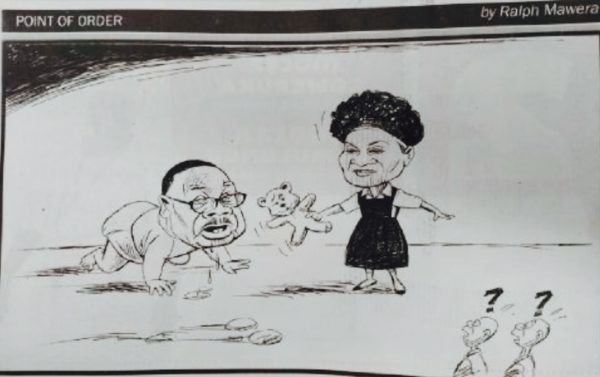
The loss, where DPP won only one seat out of six, has woken APM up from his usual deep slumber. I am told the Mayani Ward councillor, who won on a DPP ticket defected to the Malawi Congress Party a day after the polls. But I digressed.
You now see a flurry of activities by the usually laidback APM which started with him attending an Escom/Egenco board meeting. After the meeting, APM told the nation that he sees the electricity blackouts coming to an end by December. He said Egenco has procured gensets which we have now been told will be airlifted from China. But I fear for consumers who I am told should expect high electricity tariffs from the gensets power.
One thing of note that transpired from the Escom/Agenco surprise meeting which APM did not tell the nation is that an earlier arrangement to buy the gensets was botched. But that is now water under the bridge.
The Escom/Egenco meeting was followed a few days later by another surprise visit to Admarc offices in Limbe where APM announced the lifting of the ban on maize exports. Of course, the lifting of the ban came too little too late. With Admarc in a moribund state, small scale-farmers had already sold their maize to vendors at rock bottom prices. So those who will benefit from the lifting of the export ban are not the poorest of the poor farmers but the usual middlemen and those politically connected. These are the same people who were also able to sell their maize to the now much-politicized NFRA.
Then a few days later, APM replaced the Escom CEO—Evelyn Mwapasa—with Dr Allexon Chiwaya. This, needless to say, just whipped up people’s wrath over APM’s pre-election promises that a DPP administration would reduce presidential powers on appointments of CEOs and DGs for State enterprises.
Back to Mwapasa—who was removed at the same time as Paul Taulo was relocated from ODPP to Lilongwe Handling Company (Lihaco). Are they—Mwapasa and Taulo—the culprits in the botched the gensets deal? Or they were just blindfolds and that the real target was budget director Chancy Simwaka who was posted to Defense as PS, as someone confides in me: “so that they can steal from Treasury”?
Will Mwapasa’s replacement reduce the 25-hour blackouts Malawians are being subjected to? Or it is just aimed at making people think APM is concerned with the status quo and that he is not sleeping on the job?
Before long, the Directorate of Road Traffic and Safety Services announced new road traffic fees and fines, some by as much as by 1 150 percent. Hey, DPP-led government forgot that the elections are on the horizon? Government immediately reversed the decision. But at least Malawians have a glimpse of how the next APM-led government intends to punish them on traffic fees and fines.
Then before the DPP-led government could fulfill any of its pre-election promises, it makes more wild ones. APM was in Mzuzu this week where he promised his administration will build houses for staff of the Malawi Defence Force and the Malawi Police Service. Where will the money come from? Is there anything for this project in the 2017/18 budget?
No Mr. President, people don’t need more of your promises. You have failed on the Mombera University or any university for that matter. You have failed to revive your much-touted Nsanje Inland Port. You have failed to reduce cement and malata prices to enable the poor to build houses. You have failed to abolish the coupon system. You have failed to arrest plunderers of CDF, LDF, DDF … The list is endless.
Follow and Subscribe Nyasa TV :
A lot of concern has been expressed about the lack of honesty, transparency, and accountability in Malawi politics. Our political leaders are calling each other liars. The need for truth and accountability was dealt with by one of Malawi’s most respected academic jurists, back in 2003:
‘Accountability is a fundamental principle of good governance. To the extent that legitimate government is based on the consent of its people, consent can only be reasonably given when there is accountability. No people would willingly consent to a government that can act with impunity.
Accountability implies responsibility, responsibility to the people governed. Here, it implies responsibility of the Malawi government to its citizens. This responsibility is two-fold: the government of Malawi is retroactively responsible for past abuses and proactively responsible for the prevention of future abuses . . . .
Accountability may be accomplished by any combination of reparations and reconstruction efforts, but real and lasting accountability can only be achieved through the revelation of meaningful truth. There are no absolutes in the process of reconciliation; reparations are only temporary and reconstruction efforts cannot perfectly guarantee prevention of future abuse. However, the truth is an absolute, and it is the only way to achieve real accountability. Future governments will shape their behavior based on the likelihood that their actions will be exposed, and the people will measure their respect for the rule of law and authority of the government by the protection that truth can provide for them. The right to truth has been established under international law and should be claimed by the people of Malawi . . . .
There is a need for truth, and for the sake of accountability, a need for the government to recognize the people’s right to truth.’
These quotations have been extracted from:
Mutharika, A. Peter (2003) “Accountability for Political Abuses in Pre-Democratic Malawi: The Primacy of Truth,” Third World Legal Studies: Vol. 16, Article 11.
Very few academics are given the opportunity to transform their words into deeds. By his own words, the President has delivered to himself the challenge to provide the people of Malawi with the truth and accountability that are their right.
The clock is ticking.
The people are waiting.
May be a stylized equation holds: corruption = monopoly+ discretion – accountability
Klitgaard’s equation provides a useful starting point for any analysis of a specific corrupt environment. However, it could be argued that competition provides more opportunities for corruption than monopoly, that constraining discretion prevents the formulation and implementation of timely and situation-specific strategies, and that it is only when the accountability mechanisms have been carefully specified and made explicit that they can influence the conduct of bureaucracy and business.