

New Umunthu Social Index Unveiled to Measure Malawi’s Social Impact and Development Progress
Minister of Gender, Children, Disability and Social Welfare Mary Navitcha on Tuesday launched the Umunthu Social Index (USI), a groundbreaking tool designed to measure social impact, accountability and community-driven development, during a colourful ceremony held at Ufulu Gardens in Lilongwe.
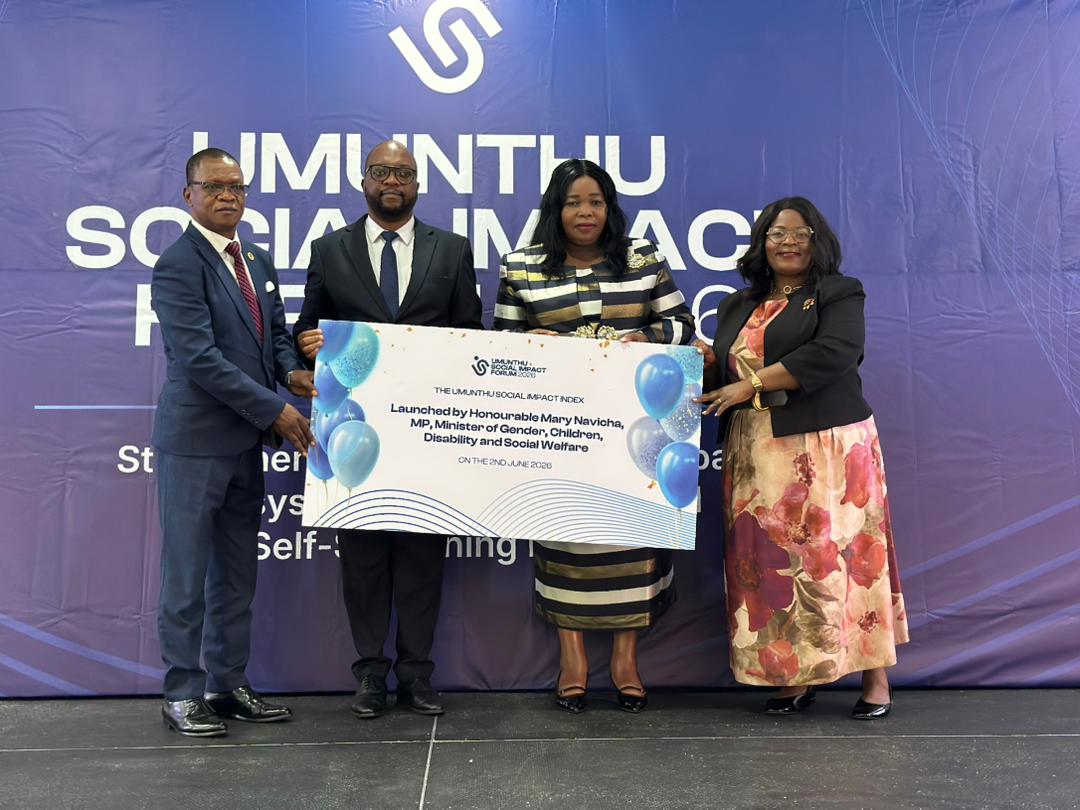
The launch took place at this year’s Umunthu Impact Social Forum, which brought together policymakers, development practitioners, civil society leaders and other stakeholders to discuss the role of social values in shaping Malawi’s development agenda.
Speaking at the event, Navitcha described the forum as more than just a gathering, saying it represented a commitment to honest dialogue, structured thinking and sustainable transformation.
“The forum is a statement on its own. It demonstrates our collective commitment to meaningful and lasting change through dialogue, innovation and collaboration,” she said.
The minister emphasized that the philosophy of Umunthu remains central to Malawi’s development aspirations, describing it as a powerful framework for nation-building.
“The Umunthu philosophy teaches that a person is a person through other people. This is more than a cultural expression; it is a guiding principle for nation-building. It reminds us that our progress as individuals, institutions, communities and as a nation is interconnected,” she said.
According to Navitcha, true development cannot be measured solely by individual achievements but by collective progress and shared prosperity.
“Our impact is not measured by what we achieve in isolation, but by what we accomplish together,” she said.
She further noted that Umunthu embraces unity in diversity and encourages citizens to work together towards common goals.
“Umunthu recognizes unity in diversity and teaches us that together everyone achieves more,” she said.
Drawing inspiration from global leadership, Navitcha cited Nelson Mandela as one of the strongest examples of Umunthu in action.
She said Mandela, despite enduring decades of oppression under apartheid, chose reconciliation over revenge and helped transform South Africa into a united nation.
“Mandela demonstrated that genuine leadership is rooted in forgiveness, inclusion and the pursuit of a shared future,” she said.
The minister said the launch of the USI comes at a critical point in Malawi’s development journey as the country works towards achieving the aspirations of Malawi 2063.
“As a nation, we continue to pursue the goals of Malawi 2063, which envisions an inclusively wealthy and self-reliant nation,” she said.
Navitcha added that President Arthur Peter Mutharika has consistently emphasized the importance of Umunthu values in driving equitable and inclusive development.
She cited the K5 billion Constituency Development Fund as one example of government efforts to promote fairness and ensure development resources are distributed across all parts of the country.
“The Constituency Development Fund is aimed at ensuring development reaches every corner of Malawi while promoting equality and fairness among our people,” she said.
The minister concluded by calling for greater collaboration among government, civil society, communities and the private sector.
“The future we seek will not be built by individual institutions acting alone. It will be built through collective action, mutual accountability and a shared commitment to the values of Umunthu,” she said.
Thrive Afrika Executive Director Wilson Chivhanga described the newly launched Umunthu Social Index as a practical tool that will help organizations assess how effectively they embed values such as shared humanity, accountability and local ownership in their work.
“The USI is not a ranking tool designed to shame organizations. It is a mirror. It helps us understand where we are performing well and where improvements are needed,” said Chivhanga.
He revealed that the inaugural baseline assessment shows Malawi’s social impact ecosystem performs strongly in community participation but faces challenges in areas such as data utilization and domestic resource mobilization.
Conference Organizing Chairperson Ruth Kulaisi said the index will play a critical role in strategic planning by converting complex social realities into measurable indicators that can inform policy and decision-making.
“These indexes provide a baseline for benchmarking progress and enable comparisons across regions, sectors, institutions and time periods,” she said.
Kulaisi explained that the index will help identify both strengths and weaknesses by highlighting areas that require targeted interventions.
“The index will reveal which sectors are performing well and which need greater attention. Areas such as health, education, civic participation and media access can now be tracked using evidence-based indicators,” she said.
She added that the index will also enhance accountability by enabling stakeholders to monitor progress through trends, data visualization and measurable outcomes.
“For example, if the Umunthu Social Index records low scores in civic information and media reliability, strategic plans can prioritize media literacy programmes, support independent journalism and strengthen transparent government communication, with clear targets linked to improving those indicators,” Kulaisi said.
Stakeholders at the forum expressed optimism that the Umunthu Social Index will become an important instrument for measuring social progress, strengthening accountability and ensuring that development efforts remain people-centred and rooted in Malawi’s enduring values of solidarity, inclusion and shared responsibility.
Follow and Subscribe Nyasa TV :