

What Suleman testimony does – and doesn’t – tell us about the search for Chilima’s plane
Daud Suleman’s appearance before the parliamentary committee investigating the Chikangawa crash was, by any measure, one of the more technically detailed sessions of the inquiry so far.
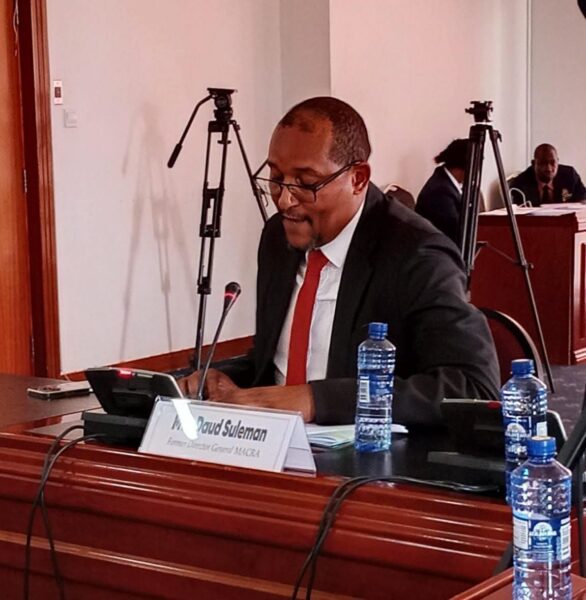
The former head of Malawi’s telecoms regulator set out, methodically, what his agency did in the hours after the aircraft carrying Saulos Chilima and eight others disappeared – and, just as pointedly, what it did not do.
The distinction matters, because public understanding of MACRA’s role in the search has been muddled almost from the outset. Suleman’s evidence was, in effect, an attempt to correct that record.
According to his account, MACRA’s involvement began on the instruction of the then Secretary to the President and Cabinet, who asked Suleman to establish whether phones belonging to people on the aircraft’s passenger manifest had registered any activity on the mobile networks.
Suleman says he contacted the chief executives of both Airtel Malawi and TNM directly. The then Airtel boss, Charles Kamoto, reported back at 16:47 that the last known tower connection for some of the numbers was near Raiply – a detail that, if accurate, would have offered searchers a rough approximate location, though not a precise one.
Suleman told the committee MACRA went further still, contacting communications regulators in Zambia, Tanzania and Mozambique to check whether the same numbers had connected to networks across the border. All three reported back in the negative.
What Suleman was careful to stress throughout, however, was the limit of what any of this data could actually show.
Mobile network information, he explained, can indicate the approximate location of a device via the cell tower it last connected to – it is not an aviation tracking system, and should not be treated as one.
Responsibility for locating, navigating and conducting search-and-rescue operations for the aircraft itself, he said, sat elsewhere, with aviation authorities.
This is a technical point, but not a trivial one. If public and parliamentary understanding of the search has conflated telecommunications data with aviation tracking capability, then expectations of what MACRA could realistically have contributed – and by extension, judgments about any perceived shortcomings in the search – may have been built on a misunderstanding of what the regulator was actually equipped to do.
Suleman was similarly precise on the more sensitive question of whether phones might have remained active after the crash.
Here, he drew a line around privacy: further detail on that would have to come from the mobile operators, he said, not from MACRA, because it involved data protections beyond the initial, narrower request made on the day.
The session also produced two moments that extended beyond the search itself. The first was Suleman’s response to online claims – some quite serious – that a Facebook post he made in the early hours of June 10 indicated prior knowledge of the crash.
His explanation, that the post reused lyrics from a song he had shared before, including a month earlier, is the kind of detail that will satisfy some and not others; what is notable is that he chose to address it under oath rather than simply online, and asked that his full posting history be considered rather than the post in isolation.
The second was his direct challenge to Madalitso Chinguwo, a UK-based British citizen of Malawian origin who has repeatedly alleged that Suleman orchestrated the crash. Suleman’s request that Chinguwo be invited to testify and substantiate the claim before the committee is a reasonable one in principle: an inquiry of this seriousness is better served by allegations tested under scrutiny than left to circulate unexamined on social media.
The committee’s vice-chairperson’s response – urging anyone with genuine information to come forward through the proper process – suggested the committee shares that view.
Suleman’s closing argument, that Malawi’s digital laws have not kept pace with cyberbullying and online misinformation, is worth taking seriously independent of his own circumstances. Whatever view one takes of the allegations against him, the pattern of unverified claims spreading rapidly online during a national tragedy is a recognisable one, and the legal framework for addressing it deserves scrutiny on its own terms.
None of this resolves the underlying questions the committee is investigating. Suleman’s account is one perspective, offered by one witness with an evident interest in clarifying his own role.
It will need to be weighed against testimony still to come from TNM and Airtel officials, including Kamoto himself, and set alongside the aviation and search-and-rescue records that fall outside MACRA’s remit.
What the session did provide, though, was the clearest account yet of where the telecommunications regulator’s involvement began, and where – on Suleman’s telling – it stopped.
Follow and Subscribe Nyasa TV :